



2026. július 16. – augusztus 30.
Janáky István terem és Zalotay Elemér terem
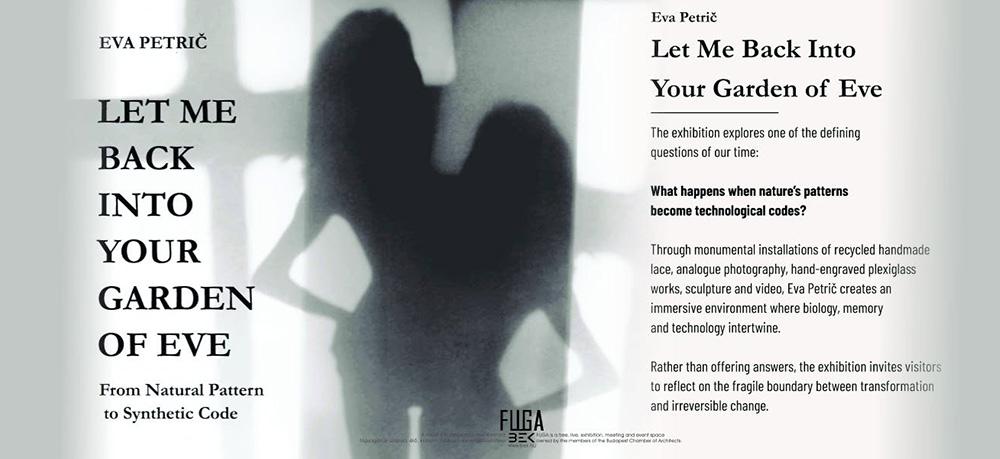
Eva Petrič’s exhibition opens in the Zalotay and Janáky halls of FUGA, which can be visited until August 30th.
The exhibition will be opened by Szilvia Csanádi Phd, art historian, aesthete, on Thursday, July 16th at 6 pm.
The curator of the exhibition: Mihály Surányi
“Let me back into your garden of Eve…
What does it mean to be human today—or more precisely, what does it mean to be an Earthling ? … Not merely an individual, but a being woven into the cycles of nature, history, technology, and memory. Lace, for me, is an universal inscription of these entanglements: it is drawing, code, bodily trace, and accumulated time.
What are the thresholds—points at which a line can still bend but does not break, the moments when technology can transform life without emptying it of meaning? The video, sound and text of Bending Point / Breaking Point articulate this tension: fear of disintegration, longing for belonging, and the question of who bears the consequences of our interventions. Furthermore, it introduces the experience of a body at its limit—a body subjected to pressure, filtration, transformation, and fragmentation. The notions of the ‘bending point’ and the ‘breaking point’ form the conceptual axis of the exhibition, asking where the threshold lies between transformation and irreversible rupture.In the exhibition title, Eve refers to the original body and biological script that contemporary technologies are reopening and reshaping. Eve is not presented as an idealized myth, but as a vulnerable and mutable living system. Through lace, video, and engraved structures, the exhibition examines the transfer of natural patterns into synthetic biology and asks where the boundary lies between transformation and irreversible rupture.
In the adjoining space, engraved plexiglass plates present human silhouettes abstracted into lace-like patterns. Here, the body is reduced to a trace, a pattern, a data-like imprint. The human figure emerges as a hybrid entity—assembled, recycled, and fragmented—an Earthling increasingly distanced from its origins.
My work does not oppose technology; it cautions against forgetting. Like Ariadne’s thread in the labyrinth of contemporary systems, I seek to preserve traces of human vulnerability, doubt, and responsibility. For if we gaze too long into the abyss of our own creations, the abyss may begin to gaze back—altered.
Rather than offering definitive answers, the exhibition opens a reflective space: can technological imitation of nature preserve vulnerability, imperfection, and ethical awareness—qualities intrinsic to human existence?”
Eva Petrič